This represents my personal opinion on the biomechanical factors that produce a straight line hand delivery path. I think that HK is perfectly correct in accurately identifying the existence of a 10-23-A or 10-23-B hand delivery pattern, but he did not discuss (as far as I know) all the biomechanical factors that produce a straight line hand delivery versus a circle hand delivery path.
This is a lengthy post - and it should therefore make it easier to falsify my opinions if they are not concordant with "reality". If someone can demonstrate that I am incorrect, then I will have learnt something "new" and I will modulate my opinions accordingly so that they are more compatible with "reality".
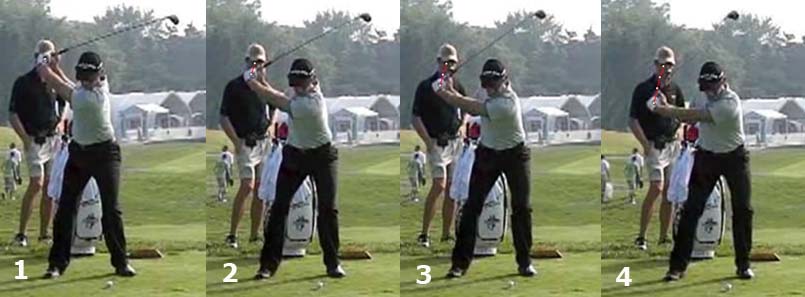
I believe that many professional golfers have a straight line hand delivery path at the start of the downswing. I will discuss two examples.
Click the flower-shaped button to see his swing as a full screen image.
This was recorded at 300 frames/second which makes it easier to make capture images showing the precise movement of his hands during the downswing.
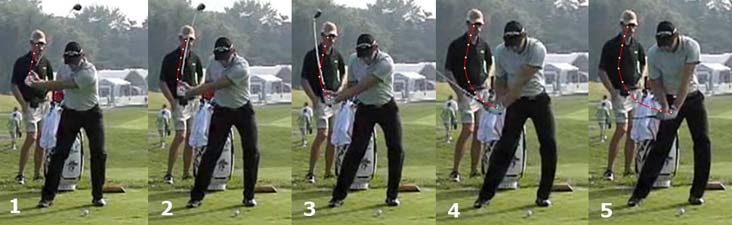
I used a spline tool to trace his hand arc at the start of the downswing - red line. Note that the hand delivery path line is "straightish". Note that there is no release of PA#4 which means that there has been no independent rotation of the left arm about the left shoulder socket fulcrum. Note that he has initiated the downswing with a pelvic shift-rotation movement (hip squaring movement) which has caused his shoulders to rotate slightly around his spine.
One can therefore rationally conclude that the "straightish" left hand motion is due to the pivot action - the movement of the torso and subsequently the movement of the left shoulder socket in space, and not due to any independent rotational movement of the left arm at the level of the left shoulder joint.
Next photo showing the next section of the hand delivery path.
These 5 photos demonstrates the effect of the release of PA#4 - which causes the left arm to rotate at the level of the left shoulder socket joint.
Note that the hand delivery path becomes more rounded - mainly due to rotation of the left arm from its left shoulder socket fulcrum point (although the left shoulder socket is still moving slightly in space). This rounded section represents the end pulley section of the endless belt, and when the hands pass through this circular section, they will induce a passive release of the club in a swinger.
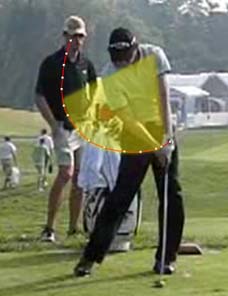
Note that the club release is a random release and that it happens gradually. Why? I believe that it is because the rounded section blends very smoothly with the straight line section and there are no abrupt changes in direction of the hands betwen the 'straightish' section and the pulley section (where the pulley is large). The entire arc is very rounded in appearance - see next photo.
Note how rounded the entire hand arc appears. The section in yellow is due to the release of PA#4 and involves the rotation of the left arm around the left shoulder joint axis. The section above the yellow section is the "straightish" section that is due to the pivot action. I think that the 'straightish" section blends very seamlessly with the lower rounded section (with no abrupt changes in direction) because Badds has a very centralised pivot action - note his stationary head and note his S&T-style centralised pivot action.
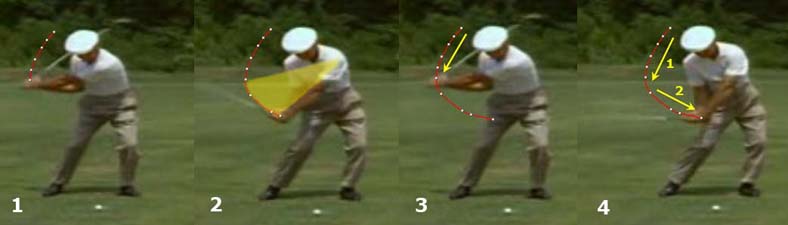
Now compare his hand arc to Ben Hogan's hand arc.
Image 1 shows the "straightish" section of Hogan's hand arc - due to the pivot action and occurring prior to the release of PA#4. Note that the straightish section lasts longer than Badds' straightish section and note that it is directed more backwards (away from the target).
Image 2 shows the rounded section of Hogan's hand arc - due to the release of PA#4 and note that it involves the rotation of the left arm around the axis of the left shoulder socket joint.
Note how Hogan's hands undego an abrupt change of direction at the start of the rounded hand arc section (start of the pulley section of the endless belt) - the point between arrows 1 and 2 in image 4. That represents a more abrupt change in hand direction - compared to Badd's swing. That is equivalent to a small pulley with a small radius (tight curve). Note that it produces a very fast release - note the difference in clubhead lag between image 1 and image 2, and between image 3 and image 4.
I believe that Hogan's straightish section, which is due to the pivot, lasts longer and is directed more backwards (compared to Badds more centralised pivot action) - because his pivot action is very different in the magnitude of the left-lateral pelvic shift and because his hands start the downswing from a different end-backswing position.
My general conclusion is that the "straightish" section of 10-23-A is due to the pivot action and not due to any independent motion of the left arm around the left shoulder joint axis. I also think that different golfers have different "straightish" hand arc sections - because of variations in the pivot action. I think that any straight line thrust "feeling" of PP#3 towards an aiming point (at the ball or near the ball) in a swinger doesn't affect the shape of the hand delivery path - because a swinger doesn't drive load using PP#3. He uses PP#3 to sense/control clubhead lag.
I think that beginner golfers often do not have a "straightish" section (a 10-23-A hand delivery path) because they may have i) a poor pivot action and/or they may have ii) an incorrect kinetic sequence if they start the downswing with an arm motion that involves a wrist or a right arm throw action.
Another point of interest.
1) During the "straightish" section of the hand delivery arc, the clubhead arc is still circular. That means that the clubhead must be subjected to a centripetal force. However, the centripetal force is not directed at the left shoulder socket, but must be directed at the center of the circle causing the clubhead motion and that center must be located somewhere in the body between the upper and lower torso.
2) During the rounded section of the hand delivery path (yellow colored section in Hogan's image 2), the left hand is traveling in a circle, which means that a centripetal force applies to the movement of the left hand. The likely center of the circle of the left hand's circular motion is at (or near) the left shoulder socket joint. During this phase, the clubhead arc is also rounded which suggests that it must also have a central axis of rotation if it is under the influence of a centripetal force. However, it doesn't have a "true" central axis of rotation despite its circular path, because it is under the influence of a centrifugal release force, and not a centripetal force.




 Threaded Mode
