
|
Left hand rotation through the impact zone
In a swinger's action, do you believe that the 180 degree rotation of the left hand and clubface from the third parallel position (where the toe is up) to the fourth parallel position (where the toe is up) involves active movements of the upper limbs below elbow level?
Here is how Ben Hogan described the action. ""What is the correct integrated motion the two arms and hands make as they approach the ball and hit through it? What does it feel like as it is happening? Well, if there is any motion in sports which it resembles, it is the old two-handed baseketball pass, from the right side of the body." He used the following diagram in his book. 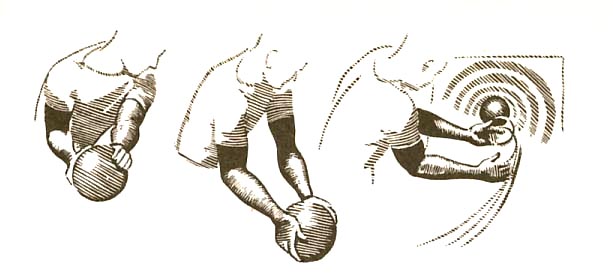 Jeff. |
A great drill that I have used for years to help students to learn the proper sequence of motion to and through impact.
|
Quote:
|
12PB
I presume a neutral grip with the clubface parallel to the back of the flat left wrist-hand. I believe that the clubface rotates about 90 degrees between the delivery position (third parallel) and impact, and about another 90 degrees between impact and the fourth parallel position when the toe points up. It's not critical whether it is 180 degrees or slightly less than 180 degrees eg. 160 degrees. My question relates to whether the 160-180 degree rotation is due to active movements below elbow level or whether it is primarily due to movements occurring at shoulder level +/- the effects of torso rotation. Jeff. |
Underhand or Sidearm?
Image #2 leaves me with the impression of preparation for an "underhand" toss similar to Ballard's shag bag toss. Image #3 however appears to be the result of a sidearm delivery. If the latter is correct, it would suggest a vertical hinge is required when the ball is released. What is the correct delivery of the "old two-handed basketball pass?"
Quote:
|
Shouldn't the right arm and ball be going down toward the ground and not forward toward the target? Down and out?
|
mb6606
If one performs a two-handed basketball pass starting from the right side, the hands have to move in a circular motion, and not a straight line motion. Therefore, the first part of the throw motion has the ball moving down-and-out-and-forwards before it move up-and-forwards towards the target. Also, I presume that Hogan was mainly trying to give a golfer a "feeling" of how the hands move in space. The key point, from my perspective, is that there is no independent right forearm pronation movement and no independent left forearm supination movement when throwing the ball - because that would cause the ball to spin around an imaginary horizontal axis through the ball's center. The hands rotate in space during the ball throwing action - due to biomechanical actions occurring at the level of shoulder sockets + due to rotation of the torso (which move the shoulder sockets in an arc). Jeff. |
I've always wondered if that graphic is intented to convey putting overspin on the basketball?
Jeff - unless you have perfect, on plane, alignments, I would say yes, for most people there needs to be an active 'action' at release point. That lead forearm rotation is the single most important, and missing, part of the majority of high handicap motions. While a proper hinge action is the next step, I think most good players got there by first learning to roll the lead forearm with intent (learning to hook), and then backing off to learn a proper hinge. If you look at someone like J. Miller, he had to roll, and roll hard from top. So did Hogan. |
Ed
What release point? What specifically must be "active"? Why must it be active rather than passive? Jeff. |
Here is a simple experiment that supports my opinion that all movements of the left upper limb are passive in a golf swing.
In Yoda's Alignment Golf DVD he demonstrates an extensor action drill where he grabs the left wrist with the his right hand with the right palm facing the ventral surface of the left wrist, and facing the target at address. Now, perform a backswing motion from that address position using the typical right forearm takeaway motion while allowing your shoulders to rotate about 90 degrees and your pelvis about 45 degrees. Aim to get your hands somewhere near the right shoulder, or just behind the right shoulder. Note that your watch on your left wrist ends up facing the sky at the end-backswing, which means that there must have been internal rotation of the left humerus at the left shoulder socket joint and some left arm pronatory movement at the level of the left forearm. However, all of this left arm's movement was "passive" because the right hand carried the left wrist to the end-backswing position. Now let the process reverse naturally. When the process reverses - by simply moving your right hand back to where it started with the right palm facing the target - you will note that the left humerus automatically/passively undergoes internal rotation at the level of the left shoulder socket and the left forearm automatically/passively supinates. In other words, as long as the right hand "guides" the movement of the left upper limb, there is no need for any active left upper limb movements in the downswing to cause the back of the left hand to face the target at impact. As long as the right forearm paddlewheels into impact on-plane, the back of the left hand will end up facing the target at impact. It doesn't require any "active" left upper limb action. One can take this lesson further - continue to rotate your torso so that you face the target at the finish, with your right palm parallel to the ball-target line. Make sure that you allow your right shoulder to keep moving so that you do not "run-out-of-right-arm" and make sure that your right arm is fully straight post-impact thus ensuring that continuous extensor action is present. Note that the back of your left hand will have undergone a 180 degree rotation between the third parallel and the fourth parallel position - and that no "active" left arm actions are required to produce this 180 degrees of rotation of the left hand. One simply has to allow the left humerus to automatically/passively rotate in the left shoulder socket joint while the left shoulder socket moves around to the left and back (towards the tush line). Jeff. |
| All times are GMT -4. The time now is 11:28 PM. |