
|
What Is the Follow-Through and How Can I Build My Game Around It?
An age-old term . . . What does it mean to you?
How do you practice the Follow-Through? What key alignments -- Clubhead, Face and Shaft -- do you monitor? How do you use these alignments to perfect your Short Game? |
Arms at Follow-through
I understand that the only time both arms are fully extended is at the Follow-through position. I have been looking at many still photographs of professionals in this position and it looks like they ALL have their arms connected to their sides.
My question then are the arms still connected to the upper torso (closed arm pits) at follow-through, or do they both extend out and I'm not seeing that? Thanks, Wali |
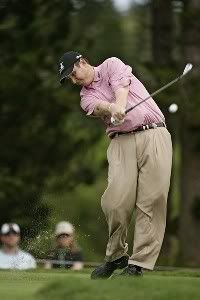
pics
  |
my take
In TGM terms Follow-Through is both arms straight. In Tiger terms it's the point in the swing where you reach out to shake hands with the target.
Winter here, so indoor I'll do alot of dowell drills. Basic motions, stop at both arms straight, look, look, look for alignments. Dowell still points to the planeline, Flat Left Wrist perpendicular to the floor for horizontal hinging, FLW perpendicular to the plane for angled, FLW perpendicular to the walls for vertical hinging. I'll hit balls into a big pillow concentrating especially on feeling the lagpressure compressing the ball, thrusting all the way through impact, low point to Follow-Through. At Follow-Through I'll evaluate, how is the FLW, shaft, leading edge and flying wedges aligned, and what kind of rhythm is connected with the different hinge actions. I hope/know that this training will help me to do some magic around the greens, but certainly it will help with alignments, feels and rhythm for all kinds of shots, short or long. ....and to Wali: I think tourpros, like most people, have their arms connected to their shoulders:eyes: |
Quote:
Thanks Thom, Kevin |
Plane is the boss!
Quote:
Mechanically, at both arms straight, the more you lift your left arm, the more it "disconnects" from the upper torso. But the position (more up/down (more disconnected/connected)) of you left arm is not randomly choosen: it is a combination of your swing plane and the way you trace the base of the swing plane at both arms straight. Imagine a very very small player with a swing plane close to horizontal. The base of the inclined plane will be very far away from his feets. If such a player correctly traces the base of this plane with his hands, he will end up at both arms straight with his hands fairly up and his arms very disconnected.......but he will be "geometrically correct". For such a player, at both arms straight, attempting to connect the arms more means lowering the arms and the hands. This will put the hands off track - under the plane - tracing is lost :naughty:. Reverse the example and picture an X-tra tall guy (say 10 meters tall!!!): From his point of view, the base of his plane will be almost at his feet. At both arms straight, his hands tracing the plane line will be very very low and his arms will be very connected..... but he will still be "geometrically correct". Plane angle is the boss here. |
Quote:
|
Quote:
It may very possible that you have a strong grip. If this is the case your left wrist would be cupped but "geometrically flat" at follow through. "Geometrically Flat" would mean that the club is still in line with your left arm at follow through. Which means you would be able place your left shoulder, left arm, and club shaft against a vertical wall at follow through. Your lower arm and wrist would not touch the wall because of the cup, but everything would be in line. Sorting Through the Golf Nut's Catalog. B-Ray |
cool, thanks. i think i was going a little further than the follow through, too. is it acceptable in tgm terms to bend the left wrist after the follow through (that would be during the swivel, i guess??)?
|
Dannyc,
Anything can be classified by The Golfing Machine, even a bent left wrist at any point in the golf swing. However I would reccommend maintaining the flat left wrist through follow through and finish swivel. The longer you can keep that left wrist flat the more control you have over the clubface and clubhead and better ball striking will follow. Sorting Through the Duffer's Bible. B-Ray |
| All times are GMT -4. The time now is 06:03 PM. |