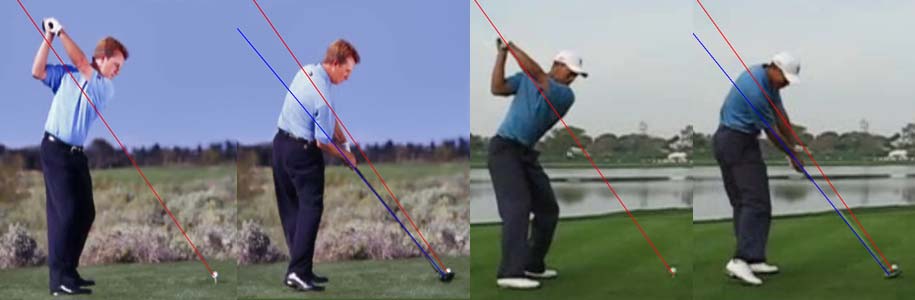
Thanks, Jeff. With regards to Plane Angle Variation (Component #7) -- and making a mental adjustment for camera placement, especially in Tiger's case -- what conclusion(s) do you draw from these photos?
I only know that there are significant variations in how golfers look in their late downswing. There are golfers like Toms/Furyk/Hogan who have their right elbow tucked well into their side with a significantly bent right elbow at impact. Then, there are golfers like Tiger Woods who lets his right elbow move well away from his right hip pre-impact and that causes his right elbow to be be straighter. TW has less plane shift than DT.
In general, I think that most golfers have a shallower clubshaft plane at impact than the angle of the TSP.
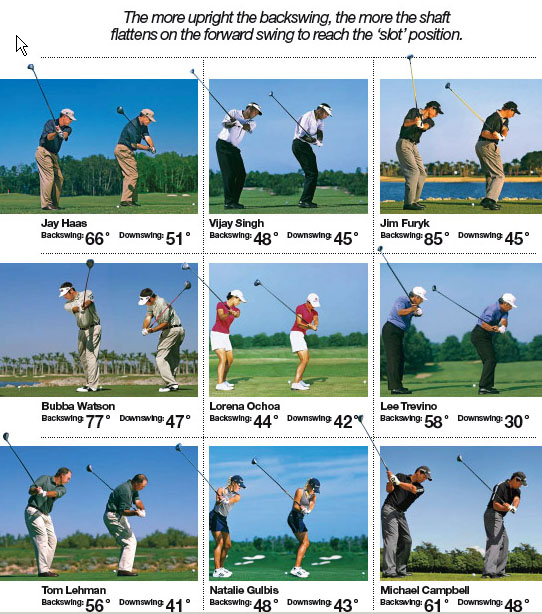
See the next photo.
I have noticed that most professional golfers, irrespective of their end-backswing clubshaft position, tend to shallow their clubshaft angle in the downswing so that they reach the delivery position on a shallower plane - roughly 45 degrees (+/- 5 degrees). I generally never see professional golfers coming steeply down the TSP line.
I only know that there are significant variations in how golfers look in their late downswing. There are golfers like Toms/Furyk/Hogan who have their right elbow tucked well into their side with a significantly bent right elbow at impact. Then, there are golfers like Tiger Woods who lets his right elbow move well away from his right hip pre-impact and that causes his right elbow to be be straighter. TW has less plane shift than DT.
In general, I think that most golfers have a shallower clubshaft plane at impact than the angle of the TSP.
See the next photo.
I have noticed that most professional golfers, irrespective of their end-backswing clubshaft position, tend to shallow their clubshaft angle in the downswing so that they reach the delivery position on a shallower plane - roughly 45 degrees (+/- 5 degrees). I generally never see professional golfers coming steeply down the TSP line.
You wrote-: "Please read 10-6-A. Tell me which pics are the "flattest normal plane"?
What are you trying to get at? I have no idea.
In a general sense, the flattest normal plane at impact is dictated by the club - it is the plane that allows the lie of the club to be "normal" (sole of the club to be horizontal to the ground) at impact, so that the the heel of the club doesn't hit the ground first.
You wrote-: "Please read 10-6-A. Tell me which pics are the "flattest normal plane"?
What are you trying to get at? I have no idea.
In a general sense, the flattest normal plane at impact is dictated by the club - it is the plane that allows the lie of the club to be "normal" (sole of the club to be horizontal to the ground) at impact, so that the the heel of the club doesn't hit the ground first.
Jeff.
2-D Pictures taken off plane conceal the truth.
Best way to truly understand the swing plane is build yourself a swing plane as in the book. Set the plane per the photos in 10-6 and swing away.
You may find it difficult to interpret 2-D DTL images in terms of swingplane, but I don't. I realize that a perfectly accurate assessment cannot be established from a 2-D DTL image that is off-axis, but it can be close enough to justify general conclusions eg. establishing that SG and TW's clubshaft comes down on a shallower plane than the TSP in the mid-late downswing, and that SG drops his hands/clubshaft down to the elbow plane early in his downswing action. Look at SG's third image - when his hands are at belt level, when his clubshaft cuts across his lower biceps and when his clubshaft cuts across his mid-lumbar spine. Adopt that position when facing a side-mirror - it is incontrovertible that your clubshaft will be just above the hand plane, and close to the elbow plane, at that time point.
Jeff.
Last edited by Jeff : 01-21-2009 at 07:43 PM.
Reason: add comment
You may find it difficult to interpret 2-D DTL images in terms of swingplane, but I don't. I realize that a perfectly accurate assessment cannot be established from a 2-D DTL image that is off-axis, but it can be close enough to justify general conclusions eg. establishing that SG and TW's clubshaft comes down on a shallower plane than the TSP in the mid-late downswing, and that SG drops his hands/clubshaft down to the elbow plane early in his downswing action. Look at SG's third image - when his hands are at belt level, when his clubshaft cuts across his lower biceps and when his clubshaft cuts across his mid-lumbar spine. Adopt that position when facing a side-mirror - it is incontrovertible that your clubshaft will be just above the hand plane, and close to the elbow plane, at that time point.
Jeff.
Why look at pics? I have a swing plane. I can locate the elbow, TSP, hand and turning shoulder planes. I can double shift, triple shift and quadruple shift planes.
Could you now offer a 'from the Top' photo comparison of Tiger and Sergio? Ideally, the sequence (and the lines you draw) will differentiate Top, Start Down, Downstroke, Release and Impact.


 Then pontificate.


 Hybrid Mode

