YodasLuke got a little impatient with all the theoretical mumbo jumbo and decided to get out the 'big club' and ball we keep around for demonstration purposes. They come in handy for communicating the finer points of TGM (such as Hinge Action). Hard to miss that Clubface!
So, does the Clubshaft rotate onto the Sweetspot's Plane or vice versa? Ted decided to put this argument to bed once and for all. Click here and see for yourself . . .
Yoda - I applaud the effort that Yodas Luke has made to resolve this issue with a personal demonstration using the big club. Unfortunately, he couldn't keep the club on-plane post-impact so it will not convince the sceptics.
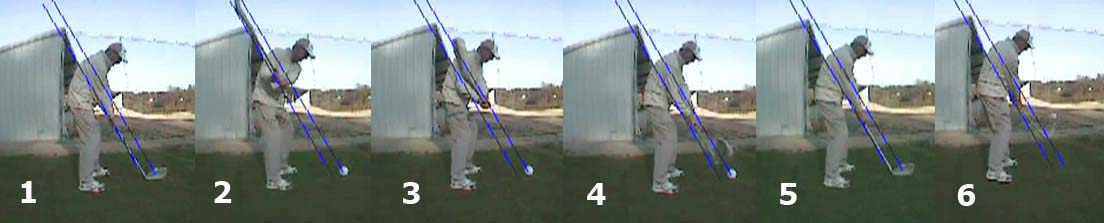
Consider my analysis of Yodas Luke's swing.
Image 1 - Address, The clubshaft is on a plane and I will arbitrarily label that plane the elbow plane. You have drawn another plane line through the sweetspot, and I will call that sweetspot plane 2. I am not calling it sweetspot plane 1, because sweetspot plane 1 apparently goes from the sweetspot to PP#3. So, I will call it sweetspot plane 2.
Image 2
That's a perfect on-plane takeaway. Note how the hosel and clubshaft remain on the elbow plane - despite a >90 degree startup swivel action. The hosel didn't leave the elbow plane and rotate to sweetspot plane 2 despite a >90 degree clubface swivel action.
Image 3
He starts the downswing with a slight OTT move that moves the hands slightly forward off the elbow plane. That causes the hosel to momentarily leave the elbow plane.
Image 4
Later in the downswing, he pulls the hands back a bit which causes the clubshaft to stay on-plane better during the release swivel phase of the downswing. Note that the hosel and clubshaft are on the elbow plane during the release swivel phase (as they were during the start up swivel phase).
Image 5
At impact, the clubshaft and hosel is on-plane, and still on the elbow plane.
In other words, Yodas Luke kept the clubshaft and hosel on the elbow plane during the start up swivel phase and also during release swivel phase of the swing, and the hosel never left the elbow plane (except momentarily when his hands went forward in a minor OTT move at the start of the downswing action).
Image 6
The clubshaft is now off-plane. It looks like he is performing a HH action, but he has allowed the clubshaft to leave the inclined plane (elbow plane). According to 10-10-D, the clubshaft should remain on the inclined plane during a HH action. Now, if anybody thinks that the hosel is leaving the elbow plane in order to rotate to the sweetspot plane 2 (as if the hosel is rotating around the sweetspot), then that interpretation cannot be correct because that should only happen by the 4th parallel. The clubface is only partially closed at this early post-impact time point, and the hosel is already on sweetspot plane 2. This is "steering" - due to a failure to keep the clubshaft on-plane post-impact. I think that Yodas Luke would have to pivot more leftwards post-impact so that he can keep the clubshaft on the inclined plane (elbow plane) during the followthrough. The inclined plane during the followthrough phase of the swing must be the elbow plane (and not sweetspot plane 2) because it has to be the same inclined plane post impact as it was pre-impact (during the release swivel phase). One cannot shift planes between the 3rd parallel and the 4th parallel and call that a symmetrical on-plane swing.
Not too shabby an effort, though. Especially considering that the club weighs about 15 pounds, its grip is about 1 1/2" in diameter, and the sweetspot is about 9" from the hosel.
Thank you Jeff, your stubbornness - real or pretending = does bring value.
And the greatest value occurs when others -- who know the truth and care that others (including Jeff) also know -- take the time and make the effort to hold his feet to the proverbial fire.
That's an amazing swing performance considering such a heavy unwieldy club.
I am therefore not surprised that he had difficulty keeping the club on the elbow plane during the followthrough, considering the effective mass (momentum of the heavy club) as it passed through impact.
What impresses me is that he kept the club near-perfectly on the elbow plane during the takeaway swivel and the release swivel phases. The fact that the hosel remained on the elbow plane during those two swivel phases surely suggests that the hosel doesn't rotate to/away from the sweetspot plane when it travels below waist level.
Please keep my feet to the fire. All my personal opinions need to be critically dissected for logical coherence and their degree of consonant concordance with objective reality.




 Hybrid Mode

