__________________
If you cannot take the shoulder down the clubshaft plane, you must take along some other path and add compensations - now, instead of one motion to remember, you wind up with at least two!
"As I've already explained twice in this thread, the Clubshaft is responding to the Sweetspot's Centrifugal Line of Pull. It is NOT creating it (as you continue to insist). In fact, this 'bass-ackwards' thinking is your fundamental error.
The Sweetspot is orbiting, and in so doing, is creating a Centrifugal Force (Clubhead Inertia resisting a change in its direction). The Clubshaft is supplying the Centripetal Force that enables that orbit."
I appreciate your input, but I have a different explanation for observed events.
I agree that the clubshaft is not creating the centrifugal line of pull. (The clubshaft is creating another force - which I will explain later).
I think that you are wrong to state the clubshaft is supplying the centripetal force. The CP force is created by the hands holding the clubshaft, and the clubshaft is simply the connecting structure between the clubhead and the hands.
Here is my explanation. I created this model.
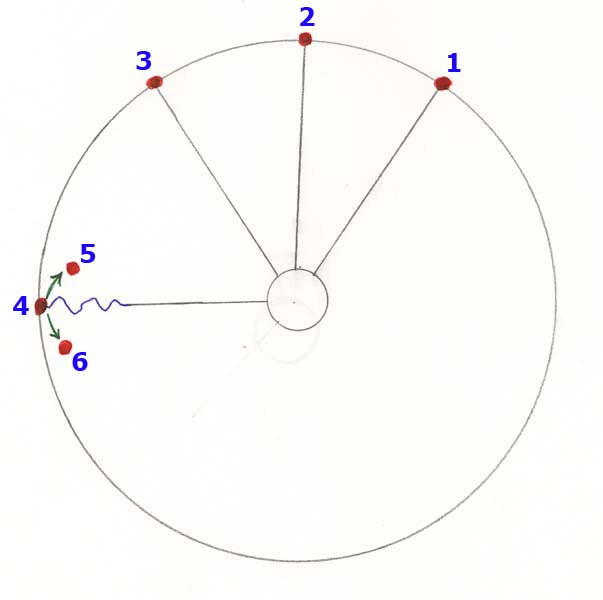
Imagine that a person is twirling a ball (attached to a piece of string) around his head. Imagine that he grasps the string between his right index finger and his thumb in a pincer grip and imagine that he holds his right hand vertically above his head and moves his right hand in a constant small circular motion. That circular motion is represented by the small inner circle.
Imagine that the string length is 18" and the red ball is attached to the end of the string.
The ball will travel in a constant circular path (represented by positions 1 and 2 and 3). The CP pull is exerted by the hands and the pull is along the length of the string and the CP force is at right angles to the ball position (right angles to a tangent at the circumference) at any point in time. The ball wants to travel in a straight line (at a 90 degree tangent to the circumference of the circle) at every moment in time, but it is prevented from that action by the CP force that is directed towards the center of the circle. The string transmits the CP pulling force from the ball to the hands (inwards pull towards the center). The string doesn't create the CP force. The ball travels in a perfect circular motion because the CP force (directed inwards towards the center via the string) balances the CF force (hypothetical outward -directed force).
Now consider placing a 6" long rigid structural object (that could be made of metal or rigid plastic) between the ball and the hands. The string length would now be reduced to 12" and it would be attached to the central end of that 6" structure which has a snake-like shape. The presence of that rigid structure, and its snake-like shape, would have no effect on the ball's path in space. The ball would continue to travel in a circle (position 4) and its motion would only be dictated by the CP force exerted by the right hand's circular twirling motion. The 6" structural unit would have no effect on the ball's path of motion - despite its snake-like shape.
Now consider what one would have to infer if the ball suddenly appeared at position 5 or 6 - where the ball is no longer on its circular path. One would have to infer that another force is at play that affected the ball's "expected" position.
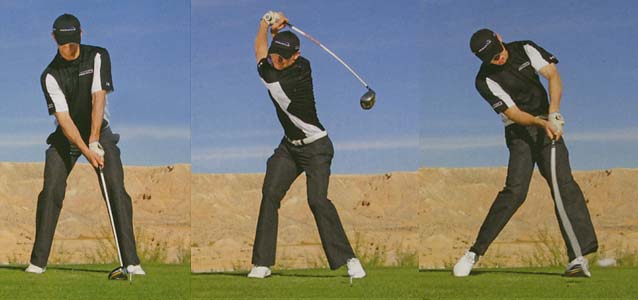
That is what I believe is happening in those photographs. I believe that there is a CP force exerted by the hands on the grip end of the club. However, I believe that there is another force (derived from the flexible clubshaft's elastic properties) that kicks the clubhead off its CP-induced orbit. In other words, when I look at Jamie Sadlowski's clubhead post-impact in this next photograph - I believe that the clubshaft's flexibility (elastic properties) is causing a displacement of the clubhead off its "expected' orbit ("expected" in the sense of the clubhead only being propelled by the CP force passing through the clubshaft from the hands-to-the-clubhead).
If the clubhead was in that position only due to the CP force, then a straight line drawn between the hands and the sweetspot should be perpendicular to a tangent line drawn at the clubhead's position on its circular orbit. However, that straight line is not perpendicular to the clubhead's circular orbit in space. I think that the clubhead is equivalent to being at position 6 in my orbiting ball-on-a-string model.
That clubhaft-shape should not affect one's ability to execute a perfect shot - if the shaft doesn't provide an additional force that interferes with the CP-CF force relationship between the hands and the clubhead.
Yoda - you wrote-: "Trust me, Jeff, that rope being swung by Jason Zuback had no trouble staying straight. If you had some footage of that event, I'm confident your 'captured images' would attest to that. Swing a pen knife 'round and 'round on a string, and you'll get the idea."
Jason had a lot of trouble keeping that flexible shaft straight at start-up - as one would when dealing with a pen-knife attached to a string. When the penknife is already in a state of circular motion, the string would definitely be straight. However, if the penknife was stationary at start-up, it has inertia, and when the penknife is first pulled by the the string, the string is not in a perfect straight line relationship between the hands centerpoint-of-rotation and the penknife. Jason's clubhead lagged far behind the hands and the flexible shaft was always curved until the clubhead's speed reached a certain level of speed that could then produce a CF that could balance the CP-force exerted by the hands. From that point onwards, the clubshaft was straight.
Another point - when Jason's timing was off the clubhead bypassed his hands in a flipping motion near impact, and the flexible clubshaft was no longer straight. That happened especially if his hands slowed down just prior to impact.
Try swinging a penknife at the end of the string and then abruptly stop the hand motion - the string will not remain straight and the penknife will no longer remain in its circular orbit!
Jeff.
Last edited by Jeff : 12-19-2008 at 03:25 AM.
Reason: Add another point
Clarifying statements regarding the string-ball example.
When I state that an additional force can throw the ball off its orbit, the force doesn't come from the string. The force can occur when the hands do not constantly move along a circular path at a smooth rate of speed - which provides the centripetal force. So, the following factors can disrupt the ball in its orbit.
1) Sudden hand over-acceleration movement (equivalent to Hk's over-acceleration idea).
2) Sudden hand deceleration movement (equivalent to quitting on the shot).
3) Hand motion becomes non-circular (equivalent to HK's steering idea).
4) Sudden change in the radius of the hands' circular motion (which causes a sudden non-circular motion as the hands move to an orbit of different radius).
Also, when I state the clubshaft's flexibility causes the clubhead to move off its orbit, I mean that it allows it. The fundamental cause is the slowing of the hands pre-impact, and the shaft flexibility allows the clubhead to move out of its perfect circular path.
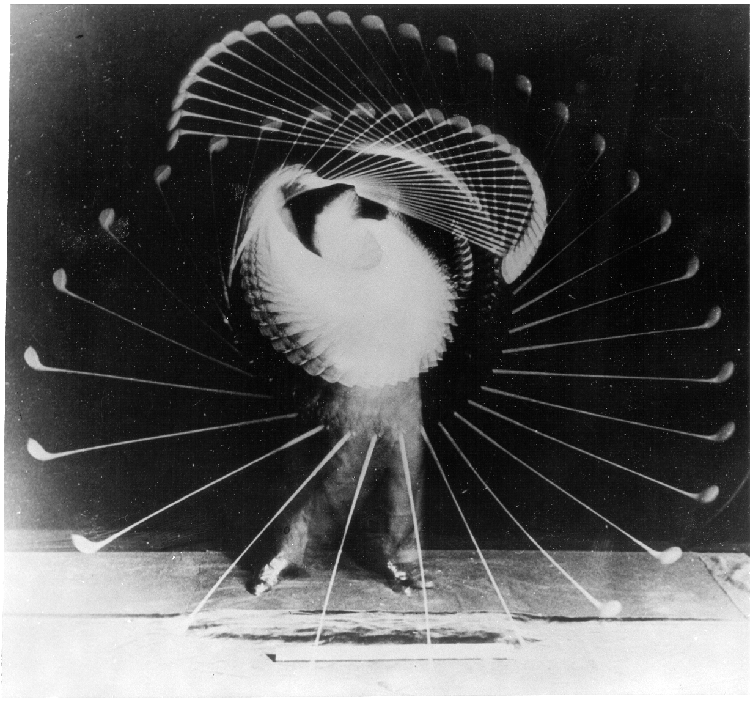
Here is a strobe photo of Bobby Jones swing.
What causes the clubhead arc to be circular? The answer - the circular motion of the hands. Anything that disrupts the smooth circular motion of the hands (over-acceleration, quitting, steering) will disrupt the clubhead's circular motion. An overly flexible clubshaft only makes these problems more apparent.
The answer is obviously Yoda. He made that decision independently. I suddenly found this "Golf By Jeff" section recently. If he wants to remove this section from his website at any time, he doesn't need anybody's permission because it is his website.
While this "Golf By Jeff" section exists, I will ask questions, freely debate issues, and never personally insult any forum member (by means of an ad hominem attack) for harboring a contrary point of view.






 Linear Mode


