I think that you are missing the point. I am not recommending that anybody emulate the Gulbis/Creamer approach. I only posted their swings as extreme examples of golfers who don't have a stationary head and who don't have anything resembling a pivot center in their swing, and yet they can consistently hit the ball well enough to play at a professional level. The question that it raises is what is the primary function of a i) stationary head; ii) a pivot center; and does the pivot center have to centralised between the feet throughout the swing.
You are free to express your opinions on this issue.
I think that you are missing the point. I am not recommending that anybody emulate the Gulbis/Creamer approach. I only posted their swings as extreme examples of golfers who don't have a stationary head and who don't have anything resembling a pivot center in their swing, and yet they can consistently hit the ball well enough to play at a professional level. The question that it raises is what is the primary function of a i) stationary head; ii) a pivot center; and does the pivot center have to centralised between the feet throughout the swing.
You are free to express your opinions on this issue.
Jeff.
Professional golf is a math contest. Two of the best ballstrikers on tour last year, Riegger and Durant, lost their cards. This forum is about hitting the ball at the target in an efficient and uncompensated way. Yes, you can move your head. Yes, you can compensate for that. But why would you want to?
Seeing that nobody has posted deep thoughts on the idea of a pivot center and/or stationary head, I will post my personal opinions. Feel free to criticise them. I have been wrong many times in the past and I am willing to modify my opinions in the face of constructive criticism.
I think that the pivot plays a number of roles in a golf swing. It powers the swing via the loading and release of PA#4. It transports the intact power package assembly downplane at the start of he downswing. Finally, it forms a stable supporting structure during the release of the PA#4/2 so that a golfer can generate an on-plane clusbhaft movement (that traces the SPL) and that results in a consistent low point position.
In other words, for a golfer to consistently swing and have the low point at exactly the same spot (for a particular club) requires a stable supporting pivot structure.
Consider this swing video lesson by Shawn Clements.
Note how he can swing back-and-forth consistently because he has a stable pivoting structure - which he likens to a construction crane. I think that's a good analogy. A construction crane cannot be unstable/wobbly if it wants to perform its role correctly/optimally.
What part of the pivoting structure plays the key role in this stable supporting structure during the downswing.
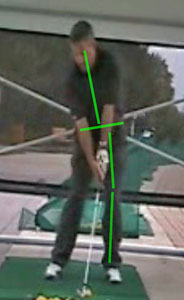
I think that its the skeletal structure that runs from the C7 vertebra down the spine to the pelvis passing through the pelvis to the left foot via the braced left leg - as seen in this next photo.
I have placed green lines to identify the key skeletal structures that allows a golfer to pivot in a stable manner. The left lower limb needs to be braced and the secondary spinal axis tilt must also be braced to keep the entire pivoting structure stable during the downswing. The head sits atop this structure and is a marker for the stability of that pivoting skeletal structure. Actually, it is acceptable for the head to drop downwards-backwards if a golfer has a large degree of secondary axis tilt as long as the base of the neck (C7 vertebra) doesn't move. That's why I can understand Homer Kelley stating that the base of the neck is equivalent to the stationary head as a marker of a stable pivot.
Does the head (or C7 vertebra) have to be situated in the center of the stance for a golfer to have a stable pivoting structure. I don't think that it's a necessary requirement.
Consider Shawn Clement in his one-leg drill.
He has no pivot center or any possibility of a centralised stance.
However, he can swing very consistently to a consistent low point in his downswing.
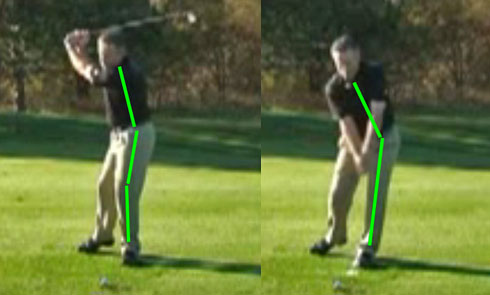
This composite photo shows the change in his degree of secondary axis tilt during the downswing.
Obviously his head has to move during the downswing. However, he is still creating a stable pivoting structure that is consistently stable swing-after-swing. Also, note that his stance (with his right hip cleared way back) forces him to have a large degree of secondary axis tilt at address. However, that doesn't mean that one cannot have a stable pivot in the downswing.
In other words, I think that variable degrees of rightwards tilt at address (and during the downswing) is still compatible with the concept of a stable pivoting skeletal structure. I think that the position of the base of the neck (C7 vertebra) relative to the center of the stance depends on the swing style and not the stability of the pivot.
Consider Mike Bennett's swing - he is the originator of the S&T swing.
His head (and C7 vertebra) remain centralised between his feet because he loads over the left leg in the backswing, and he therefore does not have any rightwards pivot shift.
The same type of centralised pivot is seen in Sam Snead's swing.
Sam Snead has very a centralised swing.
By contrast, Anthony Kim's head is well behind the center of his stance.
Note how stable/stationary his head remains during the entire downswing - despite the fact that his head is well behind the center of his stance. In other words, his head is far back because he develops more secondary axis tilt than Mike Bennett or Sam Snead. However, that doesn't mean that he is a less superb ball striker. I think that he is a superb ball-striker, who has a very stable pivoting skeletal structure.
In other words, I don't think that the head (or base of the neck) has to be in the center of the stance to fulfill Homer Kelley's definitional requirement of a "stationary head" being a necessary requirement as part of the triad of essential requirements (the other two being balance and rhythm).
In other words, I don't think that the head (or base of the neck) has to be in the center of the stance to fulfill Homer Kelley's definitional requirement of a "stationary head" being a necessary requirement as part of the triad of essential requirements . . .
Nor did Homer Kelley believe that. In his textbook, he emphatically states that the ideal Pivot Hinge Pin falls "precisely between the Feet" (2-H / 7th edition). However, in his recorded teachings, he understood personal preferences and gave the golfer plenty of leeway. He did the same in The Golfing Machine:
"This book presents the 'uncompensated' Stroke as a goal, guide and progress report, not as a minimum entrance test. Compensation for physical limitation, personal preference or special purpose are actually specialized techniques."
-- Homer Kelley (3-A)
His recommendation was to set the Head in an Impact Fix (Section TWO) of the Stroke and then leave it there at least until the end of the Follow-Through (Section ELEVEN). Most golfers ignore this instruction, of course, and take their Adjusted Address (Station THREE) with their Heads set 'any old where'. Then, they have to Bob (Third Snare / 3-F-7-C) -- often significantly (check out Gulbis and Creamer) -- in order to achieve their desired Impact location during the Stroke itself.
I well remember standing directly in front of him in his study in January 1982 as he demonstrated this point. As he moved from a conventional 'head high' address, his bald head dropped at least a couple of inches as he moved into an Impact Fix. It was dramatic difference, so much so that I even snapped a photo.
If he were posting in this thread, I'm sure he would say "Put your head anywhere you want at Fix. Then, leave it there! The important thing is that your pivot has a center and that it moves as little as possible." Just like he told the five of us privileged to be in his Masters Class that day.
This is not news. I have written on the subject many times in the past few years. Search my archives.
Would you want your dentist to be moving his head all around while he drilled your teeth? How about the surgeon in the operating room?
Homer was about repetitive precision - The Machine.
Would you want your dentist to be moving his head all around while he drilled your teeth? How about the surgeon in the operating room?
Homer was about repetitive precision - The Machine.
Hey, Jerry! What's next - a description of your bowel movement? Let's keep the items " on a need to know basis" - that way! I'm not comfortable where these personal posts are going!
__________________
Life Goal- Developing a new theory of movement based on Brain Science
Interests - Dabbling with insanity
Hobbies- Creating Quality
Would you want your dentist to be moving his head all around while he drilled your teeth? How about the surgeon in the operating room?
Homer was about repetitive precision - The Machine.
Which one, Nicklaus or Gulbis, would you like to hit the ball out of your mouth or shoot the apple on your head?




 Hybrid Mode

