That statement is really an ad hominem style comment, that doesn't make your argument about TGM issues more-or-less legitimate.
Stick to arguing for your viewpoint regarding TGM/biomechanical issues. You are entitled to your viewpoint, but you are not entitled to arbitrarily assume that your opinions are more "right" than mine.
You wrote-: "You seem to keep implying that secondary axis tilt assumes the head to move back of center."
There are two ways to acquire secondary axis tilt. Your way (and mine) is to keep the head central and shift the pelvis left-laterally, which then shifts the lower lumbar spine left-laterally thereby creating secondary axis tilt. However, there is only a finite amount of space between the center of the stance and the left foot, and the body with its desired degree of secondary axis tilt has to fit within that space. Tiger Woods and Mike Austin and Jamie Sadlowski apparently need a greater amount of secondary axis tilt, and there is no room between the center of their stance and the left foot to accomodate that desired degree of secondary axis tilt. They therefore choose to have the stationary head further back - behind the center of their stance.
I believe that adopting a large degree of secondary axis tilt may be advantageous for driving the ball a long distance, but I think that it is not optimum for accuracy/control. That's why most tour professionals keep much more centered, and adopt far less secondary axis tilt, when hitting their iron approach shots.
I am incapable of adopting large degrees of secondary axis tilt because I lack the spinal/torso flexibility, so I do not have the ability to make these personal choices.
Here is a nice video clip - presumably by VJ Trolio
He shows four variations of pelvic pivot action movements. He obviously favors the last one.
I think that many tour PGA golfers prefer the first one - the conventional pivot action where one loads over the right leg and where the head is positioned slightly behind the center of the stance. Hogan used that conventional pivot action for most of his career. Are you arguing that it's a totally unacceptable choice - from a personal, or TGM, perspective?
Tiger Woods and Mike Austin and Jamie Sadlowski apparently need a greater amount of secondary axis tilt, and there is no room between the center of their stance and the left foot to accomodate that desired degree of secondary axis tilt. They therefore choose to have the stationary head further back - behind the center of their stance.
All this faux "secondary axis tilt" effectively moves the ball forward . . . no?
So . . .
Why not position the ball further forward and thus eliminate the need for a "greater amount of secondary axis tilt" and the "stationary head further back"?
P.S. For newbies, there is no such term as "secondary" axis tilt in TGM. After Homer died, 'others' (I've heard Mac, but don't know for sure -- help requested from those who may know) interjected this term to differentiate between the dynamic Axis Tilt (lower spine tilted sideward during the Downstroke via the Weight / Hip Shift per 2-H and 7-14) and the requisite forward tilt" at Address (which Homer identified simply as "Waist Bend").
Bottom line: Axis Tilt is Axis Tilt. The Spine (Axis of the Shoulder Turn), having been positioned at Address, either Tilts during the Stroke or it does not. Unless you mean something else. In which case, say so. Or don't. Other than in this post, I never have used the term "secondary axis tilt". I strongly advise all who are interested in introducing and preserving a unified golfing terminology do the same.
Yoda - you asked-: "Why not position the ball further forward and thus eliminate the need for a "greater amount of secondary axis tilt" and the "stationary head further back"?"
The answer is related to the structure/biomechanics of the human golfer and the constraints of golf. If TW/MA/JS need a "fixed" amount of secondary axis tilt to keep in balance when swinging their arms that fast across the body, they cannot place the ball more forward than a point opposite their left foot because one cannot complete an arm arc that will cause the clubhead to be square at impact if the ball is positioned well ahead of the left foot.
Reagrding the question of how much secondary axis tilt is appropriate at impact. The answer depends on a golfer's pivot action style.
Look at this video.
There are 4 demonstrated pivot actions. Let's ignore pivot action number 2 as being a non-viable method because the golfer is swaying and we both agree that swaying is bad.
Consider pelvic action number 3 - the S&T swing. It is a viable way of playing golf, but there are biomechanical aspects that I don't like about that pelvic action style. Note that the spine has to be leftwards tilted at the end-backswing, and then has to become rightwards tilted by impact. I don't think that it is biomechanically efficient to reverse-shift the spine tilt during the downswing and I don't think that it is good for the back over a lifetime of playing golf. We will see in 20 years whether S&T golfers have more back problems than conventional golfers. I also don't like the fact that the outer border of the left pelvis has to move outside the outer border of the left foot in the downswing - in order to shuttle the pelvis leftwards under a reverse-tilting spine. I think that many golfers cannot shuttle the pelvis left-laterally in a smooth manner and they develop a jerky swing.
So, let's consider the difference between pelvic actions #1 (conventional swing) and #4 (Trolio swing). Note that they both involve the same amount of rightwards spinal tilt (secondary axis tilt). The difference lies in their head position. In the Trolio swing, the head is centralised in the stance because the golfer pivots more over the left leg in the backswing. However, in a conventional swing, a golfer pivots more over the right leg, which means that the head cannot be centralised. The head must be slightly right-of-center for a "given" amount of rightwards spinal tilt.
Now, which is better - the Trolio pivot action or the conventional pivot action?
You may argue that the Trolio pivot action is better because the head is centralised in the stance. However, is it biomechanically easy to pivot like Trolio. I think that it takes a special level of pelvic/hip/thigh flexibility to pivot in that manner, and many golfers do not have the biomechanical ability to pivot easily/efficiently in that manner. Have you tried that pivot style? Looking at your pivot action in your posted swing videos, I actually think that your pivot action is more conventional. In your Alignment Golf DVD you demonstrate a drill of using the right hand to pull the left hand across in a simulated backswing action - where you apply extensor action and where you pull the left shoulder behind the ball (feeling a tightening of the left shoulder girdle muscles). In that action, you seem to have a conventional pivot action movement of the lower torso and your weight is more over the right leg than the left leg at the end-backswing. Also, your head is slightly right-of-center.
It is my belief that a golfer should chose a particular pivot action style that works well for him from a biomechanical perspective - based on his physical/biomechanical abilities and limitations. For many golfers, the conventional pivot action style works best - even though it means that the head is slightly right-of-center, and even though it means that the golfer will have to utilize more left-lateral pelvic shift in his downswing action.
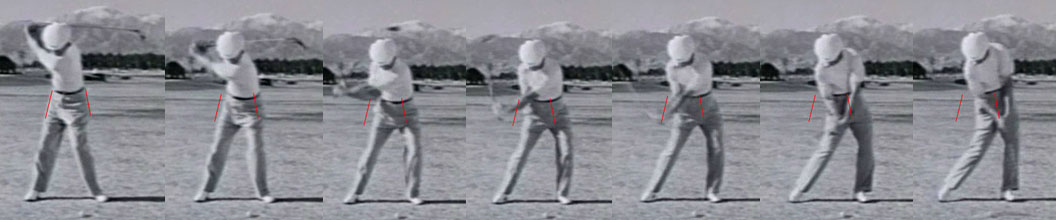
As this next photo series demonstrates, Ben Hogan used this conventional pivot action style for most of his career.
Whats wrong with Hogan's pivot action? His head is right-of-center and he needs a lot of left-lateral pelvic movement in the downswing to get from the right side to the left side. However, as we all know, a golfer can play superb golf using that type of pivot action. Even Tiger Woods knows that!
In regard to Mr Hogan's compensated driver swing. Here is my personal theory: Cavaet emptor.
-Hogan could do anything and make it work. He was a Master.
- if you or most people were to attempt to hit Mr Hogans driver, the ball would probably not get more than 10' off the ground in height.
-that he and others had/have perfected a compensated swing for such shots. A foregoing of balance in the name of increased launch angle. Nothing new here folks. You see it all the time from hackers to pros. All of this could be avoided with a move of the ball forward in the stance while still keeping the head centered for most launch angles. All except the sky rocket launch angles of the long ball hitters or the cut the corner , over the trees shot etc.
-that yesterdays golfers would have on the whole been far better served hitting brassies (2 woods) instead of drivers. Today we see driver lofts going up, as they should. I suggest that people try them and give your swing time to adjust to the added loft. If you're used to an underlofted driver you may have a built in, unbeknownst to you, head back/shoulder tilt compensation that makes these higher lofted drivers seem weird at first. Give them time to come down in launch angle while your head moves towards its centered position. Jeff Hull has a 12 degree driver I think, Yoda an 11 but their ball flight is not sky high, in the fairway probably, but not sky high.
However, are there any drivers in 11 or 12 deg. lofts that are square or even a degree or two open? It seems most of those heads are at least 2 deg. closed
OB Left - you define Hogan's swing as a compensated swing. I can understand why you call it compensated because you have in your mind an idealised uncompensated swing. I suspect that you regard a TGM-idealised uncompensated swing as a swing where the head is stationary, and where the golfer pivots around a centralised pivot axis like a spinning top. Who swings like that - who has a perfect centralised swing?
My answer = Sam Snead. I believe that he executed the "ideal" swing (a totally uncompensated swing). If I could swing in any possible manner, then I would like to swing like Sam Snead because he fits the HK ideal of a perfect centralised swing. However, very few golfers can swing like Sam Snead because it requires extraordinary flexibility - not only hula hula spinal flexibility, but extraordinary flexibility of the hip joints, shoulder joints, elbow joints and wrist joints. Sam Snead was ultra-flexible. He called it "looseness". Other golfers thought that he had long tendons. In reality, I suspect that he had a genetic variant of a physical condition that results in increased elasticity of ligaments and tendons and joint capsules. The best word that I ever heard to describe Sam Snead's body movements is "pantherine". People say that when he walked on the golf course, that it seemed like he wasn't walking, but it looked like he was gliding over the surface of the fairway - like Fred Astaire on a dance floor. I think that Sam Snead is to golf, what Fred Astaire is to dance - an extraordinary talent who was genetically endowed with extraordinary physical attributes.
Tiger Woods, and Ben Hogan, and most amateur golfers, do not have that level of flexibility and that is why they have to settle for a compensated swing.
OB Left - you wrote-: "If you are referring to the pivot I think you are then it is the one VJ prefaced by saying it was popular in the 1980's."
Wrong. You are obviously misunderstanding my posts. The swing that was apparently popular in the 1980's was pelvic action #2. I am referring to the conventional swing - pelvic action #1 - which is used by the majority of PGA tour golfers playing golf today. It's a rightwards centralised swing in contrast to the S&T swing which is a left-centralised swing. Sam Snead is the only golfer I have seen who has a perfectly centralised swing.
Jeff.
Last edited by Jeff : 12-24-2008 at 02:23 PM.
Reason: Correction - change #3 to #2
OB Left - you wrote-: "If you are referring to the pivot I think you are then it is the one VJ prefaced by saying it was popular in the 1980's."
Wrong. You are obviously misunderstanding my posts. The swing that was apparently popular in the 1980's was pelvic action #2. I am referring to the conventional swing - pelvic action #1 - which is used by the majority of PGA tour golfers playing golf today. It's a rightwards centralised swing in contrast to the S&T swing which is a left-centralised swing. Sam Snead is the only golfer I have seen who has a perfectly centralised swing.
Jeff.
OK, I thought you meant the 1980s version where the head moves back. In regard to version one, the "conventional" golf swing as VJ describes it............he IS centered here!!!!!!! Not rightward centralized, just centered.
This difference is in what you consider to be the pivot center, the head or the base of the neck. While the base of the neck is perhaps the true pivot center its hard to see at times. For this reason people often refer to its more visible extension, the head. You, I believe are seeing a slight movement of the head to the right. I see this movement to be the logical result of the spine and neck being on different angles at address and caused by the turn of the pivot. If one were to stand straight upright and turn his shoulders .........the head would stay in place. Bend over and turn, the head moves, slightly, in an amount proportional to the angle of the neck. To be perfectly clear his pivot center has not moved here. Draw a line from his shirt label down.
Note: this is in stark contrast to your long ball hitters sway, where the pivot center and low point do move. But I sense you know this already. Are you back peddling? Good, it will serve your game better.
Why would VJ, a TGM instructor and author of a book that deals in large measure with topics such as the centered pivot, axis of rotation, COG etc call this the "conventional" swing. Because it is an uncompensated , centered swing. No wobble at the top.
Jeff, Ive got to go wrap some presents and pour a glass of wine for my wife.
Merry Christmas to you and to all that are still here right now. Get out of here and go hug your loved ones before they kill you.
Here is a nice video clip - presumably by VJ Trolio
He shows four variations of pelvic pivot action movements. He obviously favors the last one.
I think that many tour PGA golfers prefer the first one - the conventional pivot action where one loads over the right leg and where the head is positioned slightly behind the center of the stance. Hogan used that conventional pivot action for most of his career. Are you arguing that it's a totally unacceptable choice - from a personal, or TGM, perspective?
Jeff.
Jeff
Yes this is VJ Trolio.
If you are referring to the pivot I think you are then it is the one VJ prefaced by saying it was popular in the 1980's. I have worked hard to get it out of my swing as have others, Tiger Woods post 2001 for instance. Are we wrong to abandon this centering then? Why would we do this?
As I and others have repeatedly maintained Hogan did this for his driver swing and for a reason. An intentional foregoing of balance in return for a higher launch angle, a compensation, a compensated swing. There is nothing horribly wrong with a compensated procedure.........as long as you are good enough to pull it off and use it wisely, only when the rewards outway the risks etc. This is shotmaking. A management of the machine at address and dynamically, albeit at the expense of reliability, balance etc.
Are we going round in circles?
What do you hold as central to your swing? No pivot center, no axis of rotation, no balance! My and others field test results suggest you should revisit pivot center, axis of rotation. You may find what your swing is lacking. Far more important for you than a max'd out axis tilt. How much axis tilt does one need anyways? Not much. If this slight bump is impossible due to your back, which I doubt, why not go circle path. And leave this head back as form of axis tilt to the Zubacks and Hogans of the world.
If your head back as secondary tilt construct is based on your fused back then hear us out. Not me, us. Yoda, Henny, Bucket etc etc etc Are you trying to move the mountain closer to you? Why dont you try and move closer to it...........it aint moving.




 Hybrid Mode

