You wrote-: "Look at this from this perspective: the lead forearm clockwise turn in the backswing makes the hosel cover the sweetspot and it remains this way until the anticlockwise forearm rotation happens in the downswing. If the clubhead rotates around the shaft/hosel it would mean that both the hosel as well as the sweetspot goes out of plane together with forearm rotation back."
You do not understand my viewpoint. I have never stated that the clubhead rotates around the hosel. I have repeatedly stated that there is no rotation around the Z axis (between PP#3 and the sweetspot) and therefore the clubhead sweetspot cannot rotate around the hosel (or vica versa). I have also repeatedly stated that that the clubface sweetspot and hosel have a fixed relationship with the back of the flat left wrist/hand and that they both rotate to exactly the same degree as the left hand. I have also previously stated that the sweetspot is on an extension from the end of the clubshaft (= clubhead) that is fixedly at roughly a 90 degree angle relative to the clubshaft. The fact that the extension is at roughly a right angle to the clubshaft means that it will change its position when the left hand rotates, and it will move from one plane to another plane even if the clubshaft remains on the same plane. During that movement from one plane to another plane, the sweetspot is not rotating around the clubshaft - because there is no rotation around the Z axis.
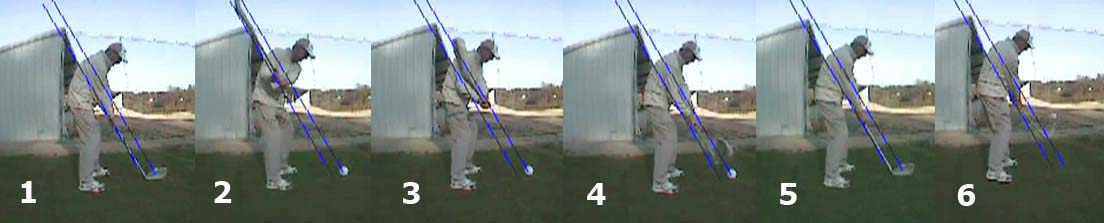
So, consider again this photo series of Yoda Luke' swing.
Image 1
At address, the clubshaft is on the elbow plane. The sweetspot in on sweetspot plane 2. The back of the left hand faces the target.
Image 2
Note what has happened to the left hand - it has rotated about 135 degrees from its address position (due to internal rotation of the left humerus and a small amount of left forearm pronation) and it it lies on the clubshaft plane at the end of an abbreviated backswing and the back of the flat left wrist/hand is parallel to the clubshaft plane, and also on the clubshaft plane. The clubshaft's hosel and clubface sweetspot have no choice - they also have to undergo that 135 degrees of rotation in unity with the back of the flat left wrist/hand. Because the hosel is in a straight line relationship with the clubshaft it doesn't shift planes during the backswing, so it remains on the elbow plane with the clubshaft. However, the sweetspot is on an extension that is a roughly at a 90 degree angle to the clubshaft. Therefore, the sweetspot rotates from sweetspot plane 2 (at address) to the clubshaft plane (by the end of the abbreviated backswing). When doing so, the sweetspot didn't rotate around the hosel - because there was no rotation around the Z axis. The sweetspot merely shifted positions from one plane to another plane because the flat left wrist/hand rotated about 135 degrees.
When the flat left wrist/hand is on the inclined plane (whatever the steepness of the inclined plane) at any time point between the top of the backswing and the third parallel, then the clubshaft and clubface must also be on that same plane. If the clubface sweetspot was on any other plane, then the clubshaft is off-plane.
From Yodas Luke's end-backswing position, the downswing should be a mirror image reversal of the backswing process. The biomechanical events causing the movement of the left hand from its end-backswing position to its impact position are the reverse of the backswing movement - they are external rotation of the left humerus and a small amount of left forearm supination. During this process the flat left wrist/hand undergoes a 135 degree rotation so that the back of the FLW/hand faces the target at impact. The clubshaft and clubface sweetspot must also undergo this rotation without there being any rotation about the Z axis. In this process, if the left hand is on the elbow plane at a point near the delivery position (because it was simply coming down the same inclined plane) and it is on the elbow plane at impact, then there was no plane shift when the clubshaft moved from the delivery position to impact. Therefore, the hosel will remain on that elbow plane during the release swivel phase. However, the clubface sweetspot has to rotate back to sweetspot plane 2 during its 135 degrees of rotation because the clubhead extension has a fixed near-right angle relationship to the end of the clubshaft. When the clubface sweetspot rotates from the elbow plane to sweetspot plane 2 during the release swivel phase of the downswing, it doesn't rotate around the hosel - because the sweetspot, hosel and left hand are all rotating at the same rpm.
You regard photo 2 as misleading because you thought that the hosel and sweetspot should be on the higher plane. Why did you think that it should happen if the flat left wrist/hand stayed on the lower plane? If the hosel and sweetspot were on the higher plane, then that would represent an off-plane motion of the clubshaft. Yodas Luke was not shifting planes during his backswing, so why should his clubshaft hosel and sweetspot shift planes?
You do not understand my viewpoint. I have never stated that the clubhead rotates around the hosel. I have repeatedly stated that there is no rotation around the Z axis (between PP#3 and the sweetspot) and therefore the clubhead sweetspot cannot rotate around the hosel (or vica versa). I have also repeatedly stated that that the clubface sweetspot and hosel have a fixed relationship with the back of the flat left wrist/hand and that they both rotate to exactly the same degree as the left hand. Jeff.
Jeff - what you describe is angled hinge action, an 'uncentered' motion that by the laws of physics (see chapter 2) is not as efficient as the ideal application, horizontal hinge and is, again, based on the laws of physics and the clubs design, at some level, controled steering. A fade is the natural result.
__________________
"Support the On Plane Swinging Force in Balance"
"we have no friends, we have no enemies, we have only teachers"
Simplicity buffs, see 5-0, 1-L, 2-0 A and B 10-2-B, 4-D, 6B-1D, 6-B-3-0-1, 6-C-1, 6-E-2
Why did Yodas Luke temporarily shift planes during the early downswing?
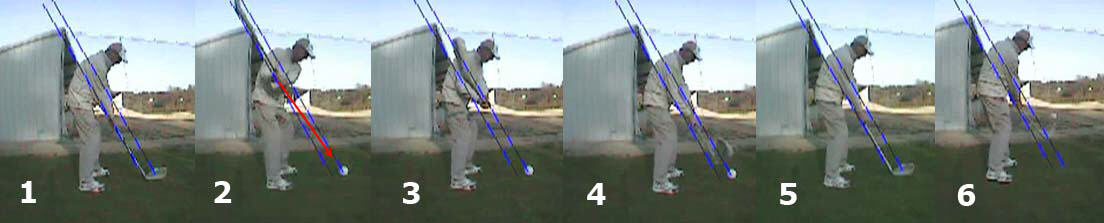
Consider this series of capture images of Yodas Luke's swing.
During the backswing, he didn't shift planes. He stayed on the elbow plane during his entire backswing. Therefore, if gets back to the same elbow plane by impact, then there should be no plane shift during the downswing.
However, he did shift planes temporarily. Note that his left hand (and therefore clubshaft) moved to a higher plane (sweetspot plane 2) in the early downswing - see image 3 - before he moved his left hand back down to the elbow plane by impact. That shifting of planes to a higher (steeper) plane and then back down to a lower (shallower) plane normally never happens in a "real" golf swing. That is equivalent to having a slight up-loop during the downswing. A golfer who has a plane shift in the downswing always shifts planes from a higher (steeper) plane to a lower (shallower) plane - and never the other way around.
So, why did it happen? I have a theory.
Normally, a good TGM-golfer directs PP#3 towards the ball-target line (base of the sweetspot plane) during the downswing - because he is trained to think that he must direct the orbiting sweetspot towards the ball-target line (base of the sweetspot plane). I think that Yodas Luke was thinking along those lines when he started his downswing - and the red arrow in image 2 represents the direction that he intended to direct PP#3. That caused his hands/clubshaft/sweetpot to go OTT - because they were directed at the base of the sweetspot plane. If he continued on that path then he would have hit the ball near the hosel of the club. He therefore had to make a "corrective" looping move a moment later to get the clubshaft back to the elbow plane by impact. Under usual circumstances this OTT problem doesn't happen. However, it becomes a "real" problem when the base of the clubshaft's inclined plane at impact is 9" away from the base of the sweetspot plane (because the actual distance between the hosel and the sweetspot is 9"), and a golfer aims his PP#3 at the sweetspot plane at the start of the downswing.
I think that hinging actions only apply to the followthrough phase of the swing and that they do not apply to the takeaway swivel action and the release swivel action. The flat left wrist/hand's swivel movement during the release swivel phase of the golf swing (its approximately 90 degree rotation between the 3rd parallel and impact) is always approximately 90 degrees in a swinger, and it is a mirror image of the degree of left hand swivel action employed during the takeaway swivel action.
Why do you regard its being an off-center motion if the back of the flat left wrist/hand and clubface both rotate to square by impact? If the clubface becomes square to the ball-target line at the exact moment of ball-clubface separation, because the flat left wrist/hand rotates to square during the release swivel phase, why is that an off-center motion?
We have major differences in understanding this topic.
I have addressed many of your issues in my post to Dariusz.
I am only going to comment on this statement that you made in your last post.
""In the backswing, he took his clubshaft up the clubshaft plane (not sweetspot plane 2)"
OK, there is a plane shift from backswing to the downswing probably exaggerated by the parallax effect. Yodasluke is not a robot. Or is he? His swing is the most precised I have observe of any human. The backswing stage is of low energy and it does not matter much that you need to keep the sweetspot on plane during a backswing. But he sure keeps the sweetspot on plane during the downswing."
Homer's definition of "on-plane" refers to the end of the clusbhaft and not sweetspot. See last paragraph of 2-F. Normally the sweetspot can be used as being equivalent to the end of the clubshaft - because it is roughly equivalent to the end of the clubshaft when the clubhead width is <4", but it will not work if the clubhead width is 18" and the hosel-to-sweetspot distance is 9". If one directs PP#3 (which you believe senses the COG of the clubhead) towards the base of the sweetspot plane at the start of the downswing when using a clubhead width of 18" (like Yodas Luke's big club) then it will result in an looped downswing action - as described in a recent post.
You wrote-" "The backswing stage is of low energy and it does not matter much that you need to keep the sweetspot on plane during a backswing."
My understanding of the sweetspot being "on plane" during the backswing (between the first parallel and the top of the backswing) is that it must be on the same plane as the back of the flat left wrist/hand. Yodas Luke successfully achieved that goal during his backswing by rotating the sweespot from sweetplane 2 to the elbow plane during his backswing.
Homer's definition of "on-plane" refers to the end of the clusbhaft and not sweetspot. See last paragraph of 2-F. Normally the sweetspot can be used as being equivalent to the end of the clubshaft - because it is roughly equivalent to the end of the clubshaft when the clubhead width is <4", but it will not work if the clubhead width is 18" and the hosel-to-sweetspot distance is 9".
Jeff,
This is the first of your posts I've read today, and there's no telling what else I've missed. As usual, though, I didn't have to read far before I found an absurd misrepresentation of TGM.
'First instance' misrepresentations -- I view those as misinterpretations -- I can handle. It is the repeat offenses that really get under my skin. Your quote above is a perfect example. Homer Kelley's operative definition of 'On Plane' references the Sweet Spot (Longitudinal Center of Gravity), not the Clubshaft. Read the first three sentences of the second paragraph in 2-F. Or just re-read my post #155 (68 posts ago) where I not only explained that fact, I actually took the time and trouble to write it out for you verbatim. Further, the last sentence of that paragraph explains precisely when the Clubshaft is an acceptable visual equivalent for both Planes. And now you come up with this drivel that once again compels me to respond.
I can draw only three conclusions regarding your persistently obnoxious behavior:
1. You don't read the replies to your tomes.
2. You read them, but choose to ignore them.
3. You read them, but when confronted with the truth, you continue to state otherwise to suit your own purposes.
Your incessant, argumentative responses and use of quotes indicate that you at least read the replies. However, you have made items #2 and #3 an artform.
Here's the problem I've got with you, Jeff . . .
I am the proprietor of this site. I pay for it every month. I have dedicated volunteers who help me deliver its content 24/7. And we have a mission, part of which is to deliver accurate information regarding Homer Kelley and his book, The Golfing Machine. Now, this may come as a surprise, but I have absolutely no problem with those who question his ideas. If that were the case, you'd have been gone a long time ago. What I do have a problem with -- a very big problem -- is someone coming along and continuing to attribute ideas to the book that are either (a) simply not there, or more often, (b) dead wrong in their interpretation.
I've lately been on the receiving end of plenty of advice from people I respect and whose opinions I value. And what they tell me is that, despite my disclaimer on the Forum Home Page (where I state that your opinions are definitely your own and not those of LBG), your presence here implies my tacit approval of the information you deliver. For better or worse, I have come to agree with them. Else, why would I waste so many hours setting things right? Only to find in the very next hour that you've come back and whacked things upside down again.
I thought I could just set up a dedicated Forum for you, leave you be and let you wander through your wonderland alone. I thought you would attract a small but interested following, and you guys could enjoy each other while the rest of us were out working, playing golf or posting quasi-normally. Sadly, I was wrong.
To the contrary, every time I come in I find instances where, as happened tonight, I simply must set the record straight. Usually, I let these recurring opportunities go: I have neither the time nor the inclination to get into pissing contests with you. But, as you can see from this and prior posts in this thread and others, I sometimes must respond, especially to the more agregious affronts to TGM. Or else be viewed as a passive constituent in your efforts. Which, to some degree, I would be, because I'm funding your operation and making it visible to the world.
We gotta do something, Jeff. I'm not sure what. You present your misrepresentations of TGM as facts, and it is taking far too much of my time to correct things. And it burns my soul when I have to let your misstatements stand unanswered because I actually have other, more valuable work to do. Which, by the way, often means writing a post in another forum that I feel will help my students and readers play a better game of golf, a situtation I believe rarely occurs when I spend my time -- no, waste my time (as I have here) -- replying to you.
You have certain redeeming qualities, Jeff, and as I've said before, I applaud your seeking nature. However, you cannot be allowed to sabatoge my mission. You have your own web site, and I am becoming more and more inclined to encourage you to pursue your activities there and not on LBG. Set up your own Forums. I promise I won't go there -- it will be out of site and out of mind -- and you'll have the whole playground to yourself. On the other hand, it takes a long time and a whole lot of effort to get 6,000+ members, so I don't blame you for wanting to hang out here. It gets pretty lonely pretty quick over at your place.
I do not want to ban you, and this exclusive Forum is the ultimate evidence of that fact. But I'm running out of alternatives. Given the obvious incongruity between your persistant attacks and my own personal mission, you may have left me no other choice.
Jeff - Ted's demonstration of horizontal hinge action is basically perfect.
Very few people ever stay on "the" plane as well as Ted, hitting or swinging.
Cognitive dissonance is in full effect for you. You are very stuck viewing the SHAFT as the plane. Per Homer the shaft is NOT THE PLANE. Even the text you quote, the shaft staying on "A" plane, you are not understanding. It isn't in reference to THE plane.
There is no 'loop or OTT' in Ted's demonstration.
__________________
"Support the On Plane Swinging Force in Balance"
"we have no friends, we have no enemies, we have only teachers"
Simplicity buffs, see 5-0, 1-L, 2-0 A and B 10-2-B, 4-D, 6B-1D, 6-B-3-0-1, 6-C-1, 6-E-2
One small correction. I realise that Homer was talking about one PLANE with respect to the orbiting sweetspot and that's the sweetspot plane. However, I also talk of the clubshaft plane. You may not understand the relevance of talking about a "clubshaft plane" (which is dictated by the rotational movement of the back of the flat left wrist/hand), but I think that you have to understand the relationship between the clubshaft plane and the sweetspot plane to really understand what is happening in the golf swing. I guess that my 'belief' in an orbiting sweetspot's plane and also a clubshaft plane represents my state of cognitive dissonance!
One small correction. I realise that Homer was talking about one PLANE with respect to the orbiting sweetspot and that's the sweetspot plane. However, I also talk of the clubshaft plane. You may not understand the relevance of talking about a "clubshaft plane" (which is dictated by the rotational movement of the back of the flat left wrist/hand), but I think that you have to understand the relationship between the clubshaft plane and the sweetspot plane to really understand what is happening in the golf swing. I guess that my 'belief' in an orbiting sweetspot's plane and also a clubshaft plane represents my state of cognitive dissonance!
Jeff.
Homer defines "the" plane as the hands (pressure points) and sweetspot. Not shaft. You may not understand the relevance of the physics, in fact, you clearly don't (nor do you understand the bold section above).
I suggest you suspend your current perspective and re-read all of the posts in this thread, and chapter 2. I'm done trying to get through to you, as you've shown little sign of incubating new perspectives so far.
__________________
"Support the On Plane Swinging Force in Balance"
"we have no friends, we have no enemies, we have only teachers"
Simplicity buffs, see 5-0, 1-L, 2-0 A and B 10-2-B, 4-D, 6B-1D, 6-B-3-0-1, 6-C-1, 6-E-2
You regard photo 2 as misleading because you thought that the hosel and sweetspot should be on the higher plane. Why did you think that it should happen if the flat left wrist/hand stayed on the lower plane? If the hosel and sweetspot were on the higher plane, then that would represent an off-plane motion of the clubshaft. Yodas Luke was not shifting planes during his backswing, so why should his clubshaft hosel and sweetspot shift planes?
Jeff.
Jeff, and why not ? The clubhead and the hand are so relatively distal things from each other that it does not change practically anything in the hands relation to the clubhead. If we assume that the club rotates around an imaginary axis coming through its CoG (assuming it comes through sweetspot as well) it is natural to suspect that the sweetspot remains on the same inclined plane all the time forcing the shaft and the hosel change its original plane to a slightly higher one. It is very logical for me.





 Hybrid Mode

